Ever wondered how a modern jetliner can gracefully maintain control at slow speeds, or how a sleek race car seems glued to the track? Often, the unsung heroes behind these feats are small, unassuming devices called vortex generators (VGs). These fixed aerodynamic surfaces, typically vanes or fins, are meticulously placed to introduce controlled swirling motions – vortices – into the airflow. Their ultimate mission: to fundamentally alter the performance impact of vortex generators on lift, drag, and stability, pushing the boundaries of what's possible in aerospace, automotive, and beyond.
At a Glance: Why Vortex Generators Matter
- Delay Flow Separation: VGs re-energize the boundary layer, keeping airflow attached to surfaces longer.
- Increase Lift: This allows higher angles of attack before a stall, reducing minimum safe operating speeds.
- Reduce Drag: By preventing large-scale separation, VGs minimize pressure drag, particularly on blunt bodies.
- Enhance Stability & Control: They ensure control surfaces remain effective even at aerodynamic limits, improving handling and safety.
- Boost Efficiency: From aircraft fuel economy to wind turbine power output, VGs unlock hidden performance gains.
- Versatile Application: Found on everything from commercial aircraft and performance cars to wind turbines and industrial ducts.
The Aerodynamic Challenge: Understanding Flow Separation
To truly appreciate the genius of vortex generators, we first need to grasp the problem they solve: flow separation. Imagine air flowing over a wing or a car body. The air closest to the surface, known as the "boundary layer," slows down due to friction. On a perfectly smooth, straight surface, this isn't usually an issue.
However, when this boundary layer encounters a curved surface, especially one where the pressure gradient opposes the flow (an "adverse pressure gradient"), it can decelerate further. If it slows down too much, it loses its forward momentum and can no longer follow the contour of the surface. It "separates" from the surface, creating a turbulent, low-pressure wake behind it.
This flow separation is an aerodynamic nightmare. On an aircraft wing, it dramatically increases drag and leads to a catastrophic loss of lift – a stall. On a car, it creates a large, turbulent wake, significantly increasing pressure drag and reducing stability. In a turbine blade, it diminishes efficiency. It's like trying to push a string; once it loses tension, it just collapses.
How Vortex Generators Master the Airflow: Re-energizing the Boundary Layer
Enter the vortex generator. These small, often triangular or rectangular fins, stand just tall enough to interact with the local boundary layer. Placed at a slight angle to the airflow, they create powerful, localized tip vortices – miniature tornadoes of air.
These vortices act like tiny, energetic pumps. They pull fast-moving, high-energy air from the free stream just outside the boundary layer and mix it down into the slower, lower-energy air within the boundary layer. This mixing "re-energizes" the boundary layer, giving it the momentum it needs to resist the adverse pressure gradient and remain attached to the surface for a longer distance. Essentially, VGs delay flow separation, allowing the airflow to stick to the surface far beyond where it would naturally detach. Learn more about vortex generators and how these clever devices manipulate the very fabric of airflow.
Elevating Performance: The Impact on Lift
The ability of vortex generators to delay flow separation has a profound impact on lift.
- Increased Angle of Attack Before Stall: By keeping the airflow attached to the wing's upper surface for longer, VGs allow an aircraft to reach a much higher angle of attack (AoA) before the onset of a stall. This means the wing can generate more lift for a given airspeed.
- Reduced Stall Speed: A direct consequence of increasing the maximum AoA is a reduction in the aircraft's minimum safe operating speed, or stall speed. Lower stall speeds translate to shorter takeoff and landing distances, improved safety margins, and enhanced low-speed handling characteristics.
- Improved Lift-to-Drag Ratio: While VGs themselves introduce a tiny amount of parasitic drag, the overall effect of delaying separation, especially on complex airfoils, often leads to a better lift-to-drag ratio. This can translate to better climb performance, greater endurance, or improved fuel efficiency during certain flight regimes.
- Maintaining Control Surface Effectiveness: On aircraft, ailerons, elevators, and rudders derive their effectiveness from smooth, attached airflow. When flow separates over a wing, for instance, it can render the ailerons useless. VGs ensure that airflow remains attached over the control surfaces, maintaining their effectiveness even at higher angles of attack or near the edge of the flight envelope, which is crucial for safety and precise handling.
For older aircraft, installing aftermarket VG kits has been a game-changer. Companies like Micro AeroDynamics offer certified solutions that demonstrably reduce stall speeds by several knots, significantly improving slow-flight characteristics and safety.
Streamlining Efficiency: The Impact on Drag
While delaying separation primarily boosts lift, vortex generators also play a critical role in reducing drag, albeit in slightly different ways depending on the application.
- Minimizing Pressure Drag: The most significant drag reduction comes from preventing large-scale flow separation. A separated flow creates a substantial low-pressure wake behind a body, leading to "pressure drag." By keeping the flow attached, VGs dramatically reduce the size and intensity of this wake, thus cutting down pressure drag. This effect is particularly pronounced on vehicles with blunt or steeply angled rear profiles, such as SUVs, trucks, or bus bodies. For these vehicles, VGs can lead to measurable improvements in fuel economy and high-speed stability.
- Aerodynamic Cleanliness: On high-performance vehicles or aircraft, VGs can be strategically placed to smooth out airflow over discontinuities or complex shapes. For example, on swept-wing aircraft, VGs can mitigate shock-induced flow separation at transonic speeds, maintaining a cleaner, more efficient flow across the wing.
- Small Trade-off: It's important to acknowledge that each vortex generator itself creates a small amount of "skin friction drag" as air flows over it. However, in properly engineered applications, this minor increase in skin friction is overwhelmingly offset by the much larger reduction in pressure drag and the gains in lift and control. For instance, while aftermarket VGs for light aircraft offer substantial safety benefits, they might introduce a minimal cruise speed penalty – often around 1.5 to 2.0 knots.
Stabilizing the Ride: The Impact on Stability and Control
Beyond lift and drag, vortex generators are critical for enhancing stability and control, particularly at the edges of an aircraft's flight envelope or a vehicle's performance limits.
- Predictable Control Response: By ensuring attached flow over control surfaces (ailerons, rudder, elevators), VGs guarantee that these surfaces respond predictably and effectively, even when the main wing or fuselage might be nearing a stall. This translates to safer, more responsive aircraft, especially during takeoff, landing, or aggressive maneuvers.
- Improved Handling at Limits: For high-performance aircraft or race cars, VGs can stabilize the airflow across complex aerodynamic elements, maintaining downforce and reducing undesirable turbulent buffeting. This allows pilots and drivers to push their machines closer to their absolute limits with greater confidence and control.
- Crosswind Performance: In some cases, VGs can improve an aircraft's ability to handle crosswind landings by maintaining rudder authority at lower airspeeds.
- Increased Maximum Takeoff Weight (MTOW): For older aircraft designs, the improved lift and control at lower speeds afforded by VGs can sometimes allow for an increase in certified MTOW, expanding the aircraft's operational utility.
Vortex Generators in Action: Real-World Applications
The versatility of vortex generators means you'll find them in a surprising array of applications, each leveraging their ability to control airflow for specific performance gains.
Aircraft: The Original Playground
VGs are perhaps most synonymous with aviation. They are absolutely critical in modern aircraft design:
- Delayed Stall: As discussed, they allow aircraft to achieve higher angles of attack before stalling, reducing minimum safe operating speeds for safer takeoffs and landings.
- Control Authority: VGs preserve the effectiveness of control surfaces (ailerons, elevators, rudder) even when the wing or fuselage is operating close to its aerodynamic limits.
- Transonic Performance: On swept-wing aircraft, VGs are used to reduce shock-induced flow separation, which can occur at transonic speeds, maintaining aerodynamic efficiency.
- Noise Reduction: In some instances, like on the Airbus A320, VGs are strategically placed under the wing to smooth airflow over pressure equalization vents, leading to a measurable reduction in aerodynamic noise by up to 2 dB. This is a subtle yet significant environmental and passenger comfort benefit.
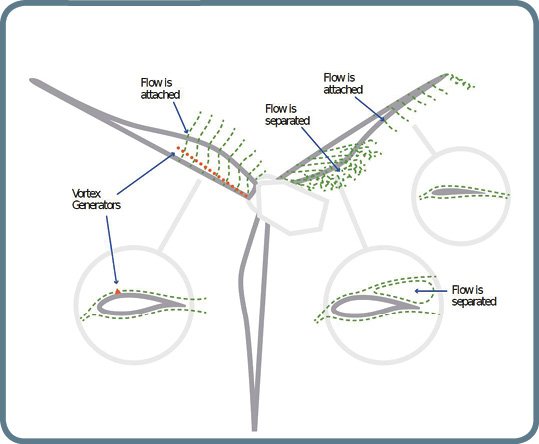
Wind Turbines: Harvesting More Power
The blades of a wind turbine are essentially miniature wings. VGs are increasingly vital for maximizing their efficiency:
- Increased Aerodynamic Lift: By delaying flow separation on the blade's suction side, VGs ensure more efficient lift generation, even at lower wind speeds or higher angles of attack relative to the blade.
- Reduced Turbulence: This leads to a smoother, more consistent flow over the blade, reducing turbulence and acoustic noise.
- Enhanced Power Output: The net effect is a significant increase in the turbine's power output across its operational range, making renewable energy more cost-effective.
Automotive: Speed, Stability, and Savings
While less visually prominent than on aircraft, VGs are making their mark in the automotive world:
- Reduced Pressure Drag: On vehicles with steep rear profiles (SUVs, trucks, hatchbacks), VGs can significantly reduce the size of the low-pressure wake, thereby minimizing pressure drag. This translates directly to improved fuel economy and reduced emissions.
- Enhanced High-Speed Stability: By cleaning up the airflow over the rear of a vehicle, VGs can reduce turbulence and improve rear-end stability at higher speeds, making for a safer and more confident driving experience.
- Performance Vehicles: On sports cars and race cars, VGs are used in conjunction with rear wings or diffusers to optimize airflow, increase downforce without excessive drag, and improve cornering stability. They help ensure air reaches the primary downforce-generating elements in a clean, high-energy state.
Industrial Applications: Beyond Vehicles
The principles of flow control that VGs offer are valuable in many other fields:
- Engine Inlets and Ducts: In jet engines, compressors, and industrial fans, VGs can prevent flow separation along internal walls, improving the efficiency of air intake, boosting compression ratios, and enhancing pressure recovery. This is crucial for optimizing engine performance and reducing energy waste.
- Piping Systems: In complex piping or ducting systems, VGs can ensure more laminar and efficient flow around bends or constrictions, reducing pressure losses and improving throughput.
Design and Placement: The Art of Aerodynamics
The effectiveness of a vortex generator isn't just about its presence; it's about its precise design and strategic placement.
- Shape and Angle: VGs typically come in rectangular or triangular shapes. They are installed at a specific angle of attack relative to the local airflow. This angle is crucial for generating the desired vortex strength and direction.
- Height: For maximum interaction and re-energization, VGs are usually sized to be roughly the height of the local boundary layer they are intended to modify. Too tall, and they create excessive drag; too short, and they can't effectively penetrate the boundary layer.
- Strategic Positioning:
- Aircraft Wings and Turbine Blades: VGs are often placed near the leading edge. This ensures that the airflow remains attached over the entire chord length, particularly over the trailing edge and crucial control surfaces.
- Fuselage or Automotive Bodies: Placement is carefully determined to smooth airflow, reduce drag, or enhance downforce. For instance, on an SUV, they might be near the rear roofline; on an aircraft, they might be ahead of a wing-fuselage junction.
- Industrial Ducts: VGs are positioned upstream of bends or diffusers where flow separation is most likely to occur.
Engineers use computational fluid dynamics (CFD) and wind tunnel testing to precisely model and optimize VG placement and geometry for each specific application, ensuring maximum benefit with minimal drawbacks.
Practical Considerations for VG Implementation
While the benefits of vortex generators are clear, their real-world application comes with a few practical considerations.
Aftermarket Kits: A Popular Upgrade
For many general aviation aircraft owners, aftermarket VG kits (such as those from Micro AeroDynamics) are a popular modification. These kits offer:
- Reduced Stall Speed: Often by several knots, significantly improving safety margins.
- Enhanced Control Effectiveness: Particularly at low airspeeds, allowing for better handling during takeoff, landing, and slow flight maneuvers.
- Shorter Takeoff/Landing Distances: Directly linked to lower stall speeds and better low-speed control.
- Improved Safety and Utility: Making the aircraft more forgiving and versatile.
Trade-offs and Challenges
No aerodynamic modification comes without some trade-offs:
- Minimal Cruise Speed Reduction: As mentioned, the added skin friction drag from VGs can result in a slight reduction in cruise speed (e.g., 1.5 to 2.0 knots for some aircraft). For most operations, the benefits in safety and low-speed performance far outweigh this minor penalty.
- Certification Costs: For aircraft, installing VGs requires proper certification, which can be a costly and complex process, though pre-certified kits simplify this for common types.
- Maintenance: Surfaces equipped with VGs can be more challenging to clean, especially for removing ice or grime. For fabric-covered aircraft, VGs might create stress points, potentially damaging the fabric over time if not properly installed and maintained.
- Aesthetics: For some, the visual appearance of VGs on a clean airframe might be a minor aesthetic concern, though this is subjective.
The Future of Vortex Generators: Smarter Aerodynamics
The field of vortex generators is not static. Researchers are continually exploring new ways to enhance their performance and adaptability:
- Active VGs: Unlike traditional fixed VGs, active systems could deploy or retract VGs on demand, or even change their angle, optimizing airflow for different flight regimes (e.g., deployed for low-speed landing, retracted for high-speed cruise). This offers the best of both worlds.
- Flexible VGs: Imagine VGs that change shape or stiffness under aerodynamic load, dynamically adapting to airflow conditions for optimal performance.
- Microfabricated VGs: Extremely small, high-density VGs, potentially integrated directly into the surface material, could offer even more precise and efficient flow control, pushing the boundaries of miniaturization in aerodynamics.
- Smart Materials: Using materials that can change shape or even generate their own micro-vortices in response to environmental cues could revolutionize boundary layer control.
Common Questions About Vortex Generators
Here are some quick answers to frequently asked questions about vortex generators:
Q: Do VGs always increase fuel efficiency?
A: Not always directly. For vehicles with blunt rear ends, VGs can significantly reduce pressure drag, leading to better fuel economy. On aircraft, the primary benefit is often improved lift and control at lower speeds, which can indirectly enhance efficiency during specific phases of flight (e.g., climb) but might slightly reduce cruise speed.
Q: Can I install VGs on any vehicle or aircraft?
A: For aircraft, VGs must be part of a certified modification kit (e.g., FAA STC) for safety and legality. For automotive applications, while general principles apply, specific designs and placements are crucial for effectiveness and must be carefully engineered to avoid detrimental effects. It's not a one-size-fits-all solution.
Q: Are VGs only for high-speed applications?
A: Absolutely not. While they help with transonic flow on jets and stability on high-speed cars, a major benefit, especially for general aviation aircraft, is improved low-speed performance, increasing lift and control authority during takeoff and landing.
Q: Do VGs create a lot of extra drag?
A: The VGs themselves do create a small amount of skin friction drag. However, in well-designed applications, this drag is overwhelmingly offset by the much larger reduction in pressure drag (by preventing flow separation) and the significant gains in lift and control. The net effect is almost always a performance improvement.
Q: Are VGs the same as winglets?
A: No. Winglets are larger, vertical extensions at the wingtip designed to reduce induced drag by minimizing the strength of wingtip vortices. VGs are small surfaces placed on the wing or fuselage to re-energize the boundary layer and delay flow separation. They address different aerodynamic problems.
Unlocking Aerodynamic Potential: Moving Forward with VGs
Vortex generators are a testament to the elegant solutions found in aerodynamic engineering. By understanding and manipulating the delicate balance of airflow and pressure, these small devices deliver outsized results, profoundly impacting lift, drag, and stability across a spectrum of applications. From making our skies safer and our wind turbines more productive to our vehicles more efficient and stable, VGs embody the continuous pursuit of aerodynamic excellence.
As technology progresses, we can anticipate even more sophisticated and adaptive VG systems, further blurring the lines between passive design and active flow control. The journey to master airflow continues, and vortex generators will undoubtedly remain a crucial tool in that quest, pushing the boundaries of performance and efficiency into the future.