Imagine the air around an aircraft wing, a wind turbine blade, or even a fast-moving truck. This seemingly invisible force isn't just a smooth blanket; it's a dynamic, often turbulent entity that dictates performance. Understanding and controlling the precise mechanisms of vortex generators: boundary layer control is critical to unlocking efficiencies, enhancing safety, and pushing the limits of aerodynamic design. It's about outsmarting the air itself.
If you’ve ever wondered why some modern aircraft wings have tiny fins, or seen small bumps on the blades of a wind turbine, you've likely encountered vortex generators (VGs) at work. These aren't just cosmetic additions; they're engineering marvels designed to manipulate airflow with surgical precision, fundamentally changing how surfaces interact with the fluid moving over them.
At a glance: Why Vortex Generators Matter
- What they are: Small, strategically placed fins, ramps, or even jets that protrude into the airflow over a surface.
- Their primary job: To energize the boundary layer – the thin layer of air closest to the surface.
- How they do it: By creating miniature vortices (swirling packets of air) that mix high-energy air from outside the boundary layer with the slower air within it.
- Key benefits: Prevents flow separation, delays stalling, reduces drag, improves lift, enhances control surface effectiveness, and boosts overall aerodynamic efficiency.
- Where you find them: From aircraft wings and tails to wind turbine blades, automotive bodies, and even industrial piping.
The Invisible Drag: Understanding the Boundary Layer's Challenge
Before we dive into how vortex generators work their magic, let's talk about the main challenge they address: the boundary layer. When air flows over any surface, a thin layer of fluid sticks directly to that surface due to viscosity. This is the boundary layer. Its speed ranges from zero right at the surface (the "no-slip" condition) to the speed of the free-flowing air a short distance away.
Think of it like this: the outermost layers of air are moving fast, but as you get closer to the surface, friction slows the air down. This creates a velocity gradient.
Ideally, this boundary layer remains "attached" to the surface. However, various factors can cause it to slow down too much and "separate" – lifting off the surface like a blanket being peeled away. This separation is the archenemy of efficiency.
Why does separation happen? Primarily due to something called an "adverse pressure gradient." As air flows over a curved surface, like the top of a wing, it speeds up, causing pressure to drop. Then, as it continues over the curve and the surface begins to flatten or curve downwards, the air slows down, and pressure increases. This pressure increase pushing against the direction of flow is the adverse pressure gradient. Slower moving air within the boundary layer struggles against this increasing pressure and eventually gives up, separating from the surface.
When the boundary layer separates, chaos ensues:
- Loss of Lift: On a wing, separation means the airflow stops smoothly following the contour, leading to a dramatic reduction in lift. This is what causes an aircraft to stall.
- Increased Drag: Instead of a smooth flow, you get turbulent eddies and wake formation behind the separation point, which significantly increases drag – robbing the vehicle or device of efficiency.
- Reduced Control: For control surfaces like ailerons or rudders, boundary layer separation can render them ineffective, making the vehicle difficult or impossible to control.
Enter the Vortex Generator: A Micro-Solution to Macro Problems
This is where vortex generators step in. They are deliberately introduced small devices that project into the boundary layer. While they come in various shapes and sizes, their purpose is universally to delay or prevent boundary layer separation.
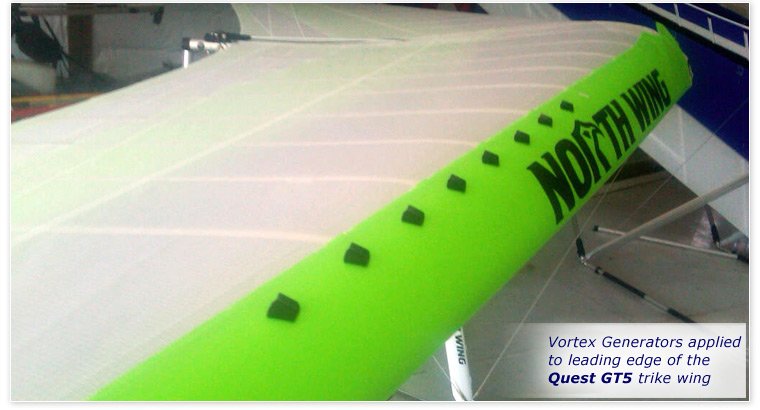
You might be familiar with the small, triangular fins often seen on aircraft wings, particularly near the trailing edge or ahead of control surfaces. These are classic examples of VGs. But their application isn't limited to aerospace. They can be found on:
- Wind turbine blades: Enhancing efficiency, especially at lower wind speeds.
- Automotive designs: Reducing drag on large trucks or optimizing airflow for cooling and stability on performance cars.
- Industrial piping and heat exchangers: Improving mixing and heat transfer, reducing fouling.
The concept of using small obstructions to control airflow isn't new. Early aerodynamicists recognized the potential, but it took significant research in fluid dynamics and experimental testing to understand the optimal designs and placements. And if you're curious about the broader family of these devices, you can always Learn about vortex generators in more detail.
The Core Mechanism: How VGs Manipulate Airflow
At the heart of a vortex generator's effectiveness is its ability to create controlled vortices. These aren't just random swirls; they are highly organized, tornado-like structures that inject energy into the sluggish boundary layer.
Here's a step-by-step look at the underlying mechanism:
- Vortex Creation: As air flows over a VG (which is typically angled relative to the local flow direction), the pressure difference across the VG's surfaces causes the air to swirl. This creates a pair of counter-rotating vortices, much like the wake behind a boat or the tip vortex off an aircraft wing, but on a much smaller scale.
- Energy Transfer: These miniature vortices are highly energetic. They act like tiny blenders, reaching out and pulling faster-moving, high-energy air from the outer part of the boundary layer (where the air is less affected by surface friction) down into the inner, slower-moving part.
- Boundary Layer Re-energization: By mixing in this higher-momentum air, the vortices effectively "re-energize" the boundary layer. They increase its average kinetic energy, making it more resilient to the adverse pressure gradients that cause separation.
- Delaying Separation: With this renewed energy, the boundary layer can maintain its attachment to the surface for longer, even as the pressure tries to force it off. This delays or prevents flow separation, allowing the aerodynamic surface (like a wing) to generate lift or reduce drag more effectively, often at higher angles of attack than would otherwise be possible.
Consider a wing at a high angle of attack: without VGs, the boundary layer might separate early, leading to a stall. With VGs, the energized boundary layer sticks to the wing, maintaining lift and control up to a much higher angle. This is a critical safety feature for aircraft, allowing for slower landing speeds and greater maneuverability.
Passive vs. Active: Varieties of Vortex Generators
Not all vortex generators are created equal. They typically fall into two main categories:
- Passive Vortex Generators: These are the most common type. They are fixed in shape and position (e.g., small fins, ramps, or bumps) and work continuously whenever air flows over them. Their design and placement are crucial for optimal performance across a range of operating conditions. They are simple, reliable, and require no power.
- Active Vortex Generators: These are more complex and can be controlled or adjusted. A prime example is Vortex Generator Jets (VGJs), which inject small, high-velocity jets of air into the boundary layer to create vortices. The advantage here is adaptability: they can be turned on or off, or their intensity varied, only when needed, minimizing any parasitic drag they might create when not required. This offers a more nuanced control over the boundary layer, particularly beneficial for complex flight profiles or highly variable conditions.
The Science Behind the Swirl: Delving Deeper into Fluid Dynamics
To truly appreciate the elegance of VGs, we need to touch upon a few more fluid dynamics principles:
- Vorticity and Circulation: Vortices are regions of concentrated vorticity – a measure of the local spinning motion of the fluid. VGs are designed to intentionally induce and sustain these regions. The strength of the vortex (its circulation) is directly related to how effectively it can mix and transfer momentum.
- Pressure Differential: The creation of a vortex inherently involves local pressure variations. The low-pressure core of the vortex, combined with the higher pressure at its periphery, helps to pull fluid into its swirling motion. This pressure differential also contributes to the "suction" effect that draws in higher-energy air.
- Momentum Exchange: This is the crux of the re-energization. Momentum is essentially mass times velocity. By transferring higher-velocity air (and thus higher momentum) into the slow-moving boundary layer, VGs effectively "boost" the boundary layer's resistance to separation. It's like giving a struggling runner a burst of energy from a stronger teammate.
The precise angles, heights, and spacing of VGs are meticulously calculated to generate vortices of the right strength and persistence to penetrate the boundary layer effectively without creating excessive drag themselves. Too weak, and they won't do enough; too strong, and they might cause new separation or undue drag.
Applications Across Industries: Where VGs Make a Difference
The impact of vortex generators extends far beyond just improving aircraft performance. Their ability to subtly yet significantly alter fluid flow has made them invaluable in diverse fields.
Aerospace: Elevating Performance and Safety
This is arguably the most well-known application.
- Stall Prevention: On aircraft wings, VGs positioned upstream of the ailerons or near the wingtip can delay flow separation, maintaining control effectiveness at high angles of attack. This is critical during take-off and landing, allowing aircraft to fly slower without stalling.
- Tail Control: VGs on vertical and horizontal stabilizers can improve rudder and elevator authority, especially at low speeds or high altitudes where air density is lower.
- Engine Inlets: They can help maintain smooth airflow into engine intakes, preventing flow distortion that could lead to compressor stalls.
- Supersonic Aircraft: VGs can be used to manage shockwave-boundary layer interactions, which are complex phenomena in high-speed flight.
Automotive: Streamlining the Ride
While less dramatic than on an aircraft, VGs play a role in optimizing vehicle aerodynamics.
- Trucks and Buses: Small VGs on the rear of trailers can reduce the low-pressure wake, significantly cutting aerodynamic drag and improving fuel efficiency.
- Performance Cars: VGs can be strategically placed to manage airflow over diffusers, rear spoilers, or even around wheel wells to improve downforce, reduce drag, or enhance cooling of brakes and engines.
- Cooling Systems: Within engine compartments, VGs can promote better mixing and flow, improving the efficiency of radiators and intercoolers.
Wind Energy: Harvesting More Power
Wind turbines are essentially inverse aircraft wings – they generate lift to create torque. VGs are crucial for maximizing their efficiency.
- Blade Efficiency: VGs on wind turbine blades help to prevent boundary layer separation, particularly at the root of the blade (where it's thicker and the profile changes rapidly) and at lower wind speeds. This allows the blades to generate more lift and extract more energy from the wind, especially in conditions that would otherwise cause partial stalls.
- Extended Operating Range: By mitigating separation, VGs enable turbines to operate efficiently over a wider range of wind speeds and angles of attack.
Industrial Applications: Beyond Vehicles
The principles of boundary layer control are just as relevant in industrial settings.
- Heat Exchangers: VGs can enhance turbulent mixing within heat exchangers, improving heat transfer rates and overall efficiency.
- Piping Systems: In certain pipe flows, VGs can prevent flow separation in bends or diffusers, reducing pressure losses and improving flow uniformity.
- Chimneys and Stacks: They can sometimes be used to reduce vortex shedding (a phenomenon that can cause structural vibrations) or improve pollutant dispersion.
Designing for Performance: Key Considerations for VG Implementation
Implementing vortex generators isn't a "one size fits all" affair. Their effectiveness hinges on meticulous design and placement, often requiring advanced computational and experimental methods.
- Size, Shape, and Angle of Attack:
- Height: VGs must be tall enough to protrude effectively into the critical outer region of the boundary layer but not so tall as to create excessive drag or disrupt the flow too much.
- Shape: Simple ramps, trapezoids, or rectangular vanes are common. Each shape creates a slightly different vortex structure, affecting its strength and penetration.
- Angle: The angle at which the VG is set relative to the local airflow (its own angle of attack) is critical for initiating the vortex efficiently.
- Placement (Location and Spacing):
- Upstream of Separation: VGs are typically placed just upstream of where boundary layer separation is predicted to occur. Their job is to prevent separation before it happens.
- Chordwise Position: On a wing, this might be anywhere from the mid-chord to closer to the trailing edge, depending on the specific flow separation issue.
- Spanwise Position: They're often placed in rows, with spacing carefully calculated to ensure the vortices interact constructively and cover the desired area without interfering negatively.
- Computational Fluid Dynamics (CFD) and Wind Tunnel Testing:
- Modern VG design relies heavily on CFD simulations, which can model complex airflow patterns and predict the effectiveness of different VG configurations.
- Physical wind tunnel tests are then used to validate these simulations and fine-tune designs in real-world conditions, measuring changes in lift, drag, and pressure distributions.
The Trade-off: While VGs offer significant benefits, they aren't without their own cost. Any protrusion into the airflow will inevitably generate a small amount of parasitic drag. The engineering challenge is to ensure that the drag reduction or performance improvement achieved by delaying separation vastly outweighs the drag introduced by the VGs themselves. This careful balance is why precise design and placement are paramount.
Common Misconceptions & Troubleshooting
Despite their widespread use, some common misunderstandings about VGs persist.
- "Vortex generators eliminate drag entirely."
- Reality: VGs manage drag by preventing flow separation, which is a major source of drag. They don't eliminate all drag; in fact, they introduce a small amount of parasitic drag themselves. The goal is a net reduction in overall drag or a significant improvement in other performance metrics (like lift or control).
- "More VGs are always better."
- Reality: There's a point of diminishing returns. Too many VGs, or VGs that are too large or improperly spaced, can create excessive drag, lead to new flow separation issues downstream, or even interfere with desired airflow patterns. Optimal placement and density are key.
- "They're only for high-speed applications."
- Reality: While crucial for high-speed flight or racing, VGs are often most effective and most needed in situations involving slower speeds or high angles of attack, precisely when boundary layer separation is most likely to occur (e.g., aircraft landing, wind turbines at low wind speeds).
- "VGs are just for fixing design flaws."
- Reality: While they can certainly mitigate unforeseen separation issues in existing designs, VGs are increasingly integrated into initial design processes as a tool for achieving optimal aerodynamic performance from the outset, allowing designers to push envelopes that might otherwise be impossible.
Pitfalls to Avoid: - Improper Placement: Placing VGs too far upstream or downstream of the separation point, or in an area where flow is already well-behaved, will yield little benefit and only add drag.
- Incorrect Sizing or Angle: VGs that are too small won't penetrate the boundary layer effectively; too large, and they become a significant drag penalty. The wrong angle will generate weak or ineffective vortices.
- Ignoring Aerodynamic Context: VGs must be considered as part of the entire aerodynamic system. Changes elsewhere on the vehicle can alter flow patterns, potentially making existing VGs less effective or even detrimental.
The Future of Boundary Layer Control
The field of boundary layer control is continually evolving, with vortex generators at the forefront of innovation.
- Smart Materials and Morphing VGs: Imagine VGs that can change their shape, size, or angle on the fly, adapting to varying flight conditions or wind speeds. Technologies like piezoelectric actuators or electroactive polymers could enable such "morphing" VGs, optimizing performance for every scenario.
- Adaptive Flow Control with AI: Combining sensors, active VGs (like VGJs), and artificial intelligence could lead to truly adaptive systems that continuously monitor the boundary layer and deploy control mechanisms precisely when and where they're needed. This could significantly enhance efficiency and safety across aerospace and other applications.
- Bio-inspired Designs: Nature has perfected fluid dynamics over millions of years. Research into the skin structures of sharks or the feather patterns of birds continues to inspire new, passive methods of boundary layer control that might one day supplement or even replace traditional VGs.
These advancements promise even greater control over the invisible forces of air, pushing the boundaries of what's possible in design and performance.
Mastering the Air: Your Next Steps
The intricate dance between airflow and solid surfaces is a testament to the power of fluid dynamics. Vortex generators, in their seemingly simple form, represent a sophisticated triumph in this dance, enabling engineers to outmaneuver the challenges of boundary layer separation.
From ensuring safer flights and more efficient wind energy production to streamlining road vehicles and optimizing industrial processes, understanding the mechanisms of vortex generators: boundary layer control is key to unlocking a world of performance improvements. Whether you're an engineer, a student, or simply an enthusiast, appreciating these tiny titans of fluid control opens up a fascinating perspective on how we interact with the world around us.
Keep exploring how these innovative solutions continue to shape the future of design and efficiency.